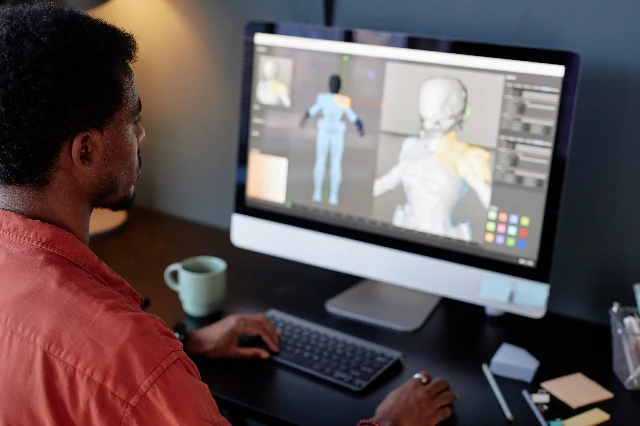
There is a massive misconception that animation is a technical skill. People think if they learn every button in Maya or Blender, they will become Pixar animators. This is false. Animation is a performance art. An animator is just an actor who happens to use a computer instead of their body.
- The Reality: Software changes every 5 years. The principles of movement haven't changed in 100 years.
- The Core Skill: "Timing and Spacing." How fast something moves defines its weight and emotion.
- The Trap: Relying on "Motion Capture" (Mocap) data without cleaning it up artistically.
- The Goal: To make a pile of digital polygons feel like it has a soul.
1. The Digital Puppet Master
Think of a 3D character model as a dead puppet. It has joints (a "rig"), but it has no life. The animator's job is to grab the strings and pull them in a way that convinces the audience the puppet is alive.
If you move a character's arm from A to B linearly, it looks like a robot. If you add an "ease-in" (starting slow) and an "ease-out" (ending slow), suddenly it looks biological. It looks like it has muscle and intent.
2. The Tool is Not the Craft
Which software should you learn? It doesn't matter. Pick one and learn the craft, then switch tools later if you need to. But here is the landscape:
Pros: Free, open-source, incredible community, does 2D and 3D.
Cons: Not yet the standard in huge Hollywood pipelines, but getting there fast.
Pros: If you want to work at Disney or Marvel, you must know Maya. Unmatched rigging power.
Cons: Extremely expensive and hard to learn.
Pros: The king of "Motion Graphics" (flying logos, abstract shapes for ads). Very intuitive.
Cons: Not great for complex character acting.
Pros: The industry standard for traditional 2D animation (like The Simpsons or anime).
Cons: Niche. Only good for 2D.
3. The Physics of Emotion
How do you show that a character is sad without having them cry?
You use physics. A sad character feels heavy. Gravity pulls harder on them. Their movements are slow, draggy, and lack energy. A happy character defies gravity; their movements are snappy, light, and bouncy.
As an animator, you are a physicist of emotion. You translate internal feelings into external weight.
Motion Capture is data, not animation. Putting a suit on an actor gets you raw movement data. It is often jittery and lacks "punch." A skilled animator must take that data and exaggerate the key poses to make it read clearly on screen.
4. The Demo Reel Checklist
Studios don't care about your degree. They only care about your reel. Does your reel show these fundamentals?
Need Motion Graphics?
We create high-end explainer videos that simplify complex ideas.